Pain and tension aren’t a normal cost of playing the violin - they’re a signal that technique is working against the body rather than with it. Played in agreement with your anatomy, most aching and strain is avoidable. Here’s what pain is actually telling you, and what to do when something hurts.
There’s a sentence many of us absorbed long before we ever questioned it: that pain is simply part of being a musician. The sore neck after a long rehearsal, the tight shoulder, the forearm that complains by the end of a concert - we’re taught, mostly without anyone saying it out loud, that this is the part of being a musician. So we nod, and we push through.
I believed it too. Then an injury took the violin out of my hands for months, and in the silence that followed, the belief finally cracked. Pain is not part of the job. Pain is a signal.
What is pain actually telling you.
The body is remarkably well designed for movement. So when playing starts to hurt, it’s rarely because the instrument is inherently punishing. It’s usually because something in how we’re using ourselves is asking the body to compensate - a sign that the technique is working against the body rather than with it (more on where technique really comes from) - and pain is how the body flags a cost it can’t keep paying.
Movement Before Effort.
Playing the violin is an active process, but it should not require more effort than the task itself demands. When the body is organised according to its natural design, stability comes from the postural system, balance replaces unnecessary holding, and movement becomes more efficient. The goal is not to eliminate activity, but to eliminate the effort that comes from working against your own body.
The Myth We Learn Early.
One of the most persistent myths in music is that discomfort or pain is simply part of our job. We learn to ignore small warning signs, assuming they are the price of progress or something every musician experiences.
Your body isn’t working against you. It’s trying to protect you. Pain is often the body’s way of asking for a different solution. Ignoring these signals doesn’t solve the problem - it simply gives inefficient movement more time to become a habit.
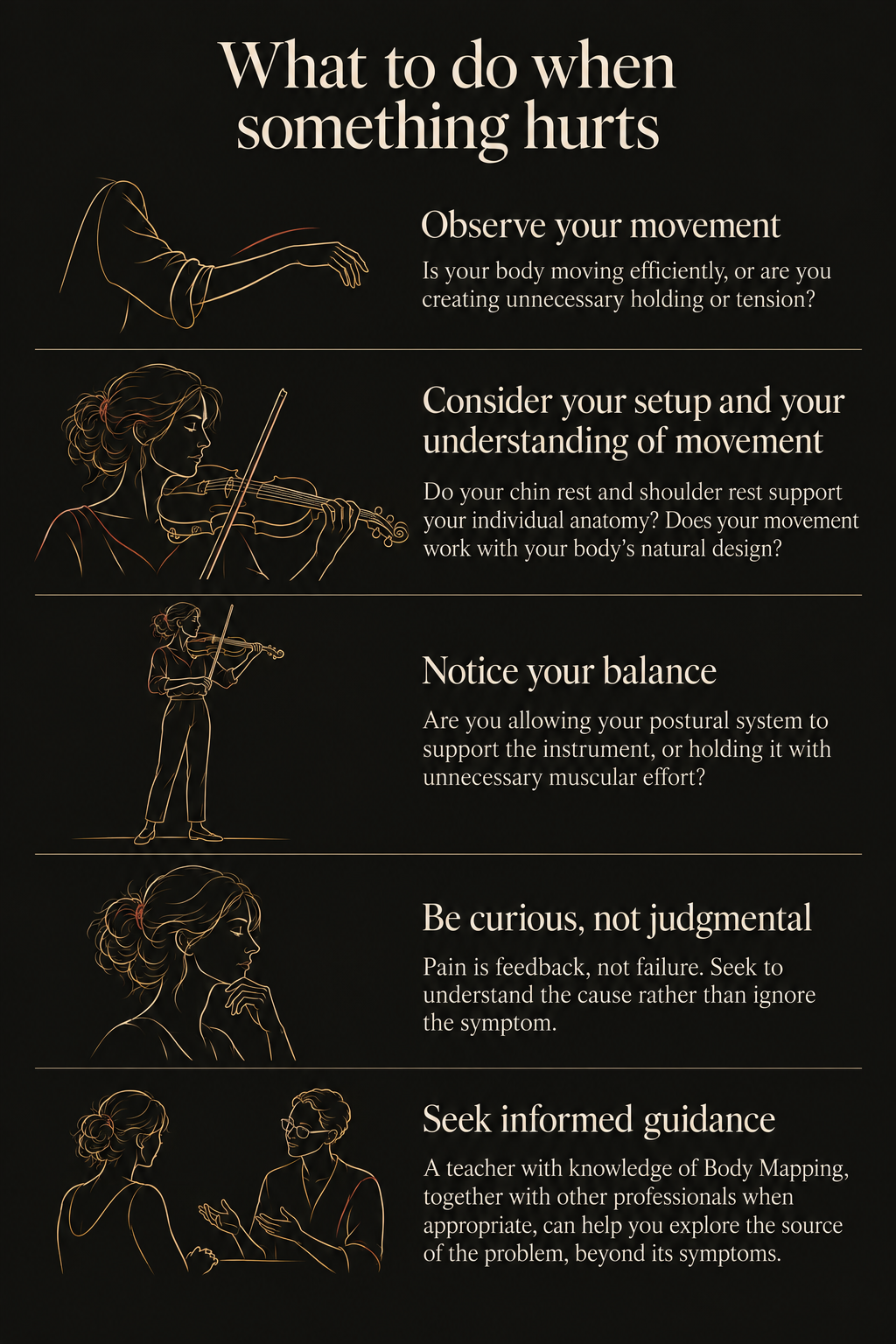
What to do when something hurts.
Pain is information, not something to ignore or push through. Instead of asking, “How can I keep playing?” ask, “What is my body trying to tell me?”
When discomfort appears, take a moment to investigate:
Observe your movement. Is your body moving efficiently, or are you creating unnecessary holding or tension?
Consider both your setup and your understanding of movement. Do your chin rest and shoulder rest support your individual anatomy, or are they asking your body to adapt to the instrument? Are your movements organised in a way that works with your body’s natural design rather than against it?
Notice your balance. Are you allowing your postural system to support the instrument, or are you holding it with unnecessary muscular effort?
Be curious, not judgmental. Pain is feedback, not failure. Understanding the cause is far more valuable than ignoring the symptom.
Seek informed guidance. A teacher with knowledge of Body Mapping, together with other professionals when appropriate, can help you identify the source of the problem rather than simply treating its symptoms.
The goal is not only to become pain-free. The goal is to understand how your body is designed to work, so that healthy movement becomes reliable and sustainable - allowing you to enjoy a lifetime of comfortable, confident music-making.
A note of honesty: I’m a violinist and a teacher, not a doctor. Persistent or sharp pain deserves a qualified specialist, and the sooner the better. Everything here is about prevention and awareness, not diagnosis.
What to notice before pain appears.
One of the most valuable skills a musician can develop is body awareness. The brain constantly receives sensory information - from what we see, hear, feel, and sense through movement. By learning to interpret this information more accurately, we build more accurate body maps, allowing movement to become easier, more efficient, and more reliable.
Pain rarely appears without warning. More often, the body sends quieter signals first - a gripping jaw, a tense shoulder, restricted breathing, or an awkward feeling in your bow hold. These are not problems in themselves; they are information.
Rather than trying to ignore them or force relaxation, become curious. What has changed? Small adjustments made early are often enough to restore efficient movement before discomfort develops into pain.
Questions I’m often asked.
Is it normal to feel pain when playing the violin.
Pain is common among violinists, but it should never be accepted as a normal or inevitable part of playing. It is a signal that something in your movement, body use, or setup may need attention - not something to ignore or push through.
What causes neck and shoulder pain in violinists.
Neck and shoulder pain rarely has a single cause. Most often, it results from inefficient body use combined with compensatory movement patterns. A chin rest or shoulder rest that doesn’t fit your body can contribute to the problem - or, in some cases, become the primary cause - but more often the setup simply amplifies movement habits that are already placing unnecessary stress on the body. Fortunately, all of these factors can be assessed and improved.
Can online violin lessons help with tension and pain.
Yes. Many of the factors that contribute to pain are visible on screen because they are reflected in the way the body is organised and how movement is coordinated. Together, we can assess your setup, your movement patterns, and the habits that may be leading to unnecessary effort or discomfort.
Work on this together.
I’m Agata Kawa-Cajler, a Polish-born violinist based in Sweden. My teaching combines violin technique with body awareness, ergonomics and Body Mapping-not because the goal is simply to avoid pain, but because understanding how your body works allows you to play more freely, more confidently and with a better sound and build a technique that will support you throughout your musical life.