Why your shoulder region matters more than you think.
Most violinists spend years trying to improve their hands. We practise scales to make our fingers faster. We work on the wrist to make the string crossing smoother. We adjust the elbow. We stretch our arms.
But very few of us ever learn where the movement actually begins.
Ironically, one of the most important parts of violin technique is also one of the least understood:
the shoulder region.
We all hear the same advice.
“Relax your shoulder”, “keep your elbow higher/lower”, “don’t lift the shoulder.”
Sometimes it helps. Often it doesn’t. Because these instructions tell us what to do, but rarely explain why.
Without understanding the movement, the body simply returns to its old habits.
The biggest misunderstanding.
Most of us think the arm moves by itself. It doesn’t. Every movement of the arm depends on the shoulder region working together.
By shoulder region I mean the collarbone (the bone you can feel just below your neck), the shoulder blade (the flat bone on your back that slides over your ribs), the shoulder joint and the muscles that connect them. Together, these structures form the foundation from which the arm moves.
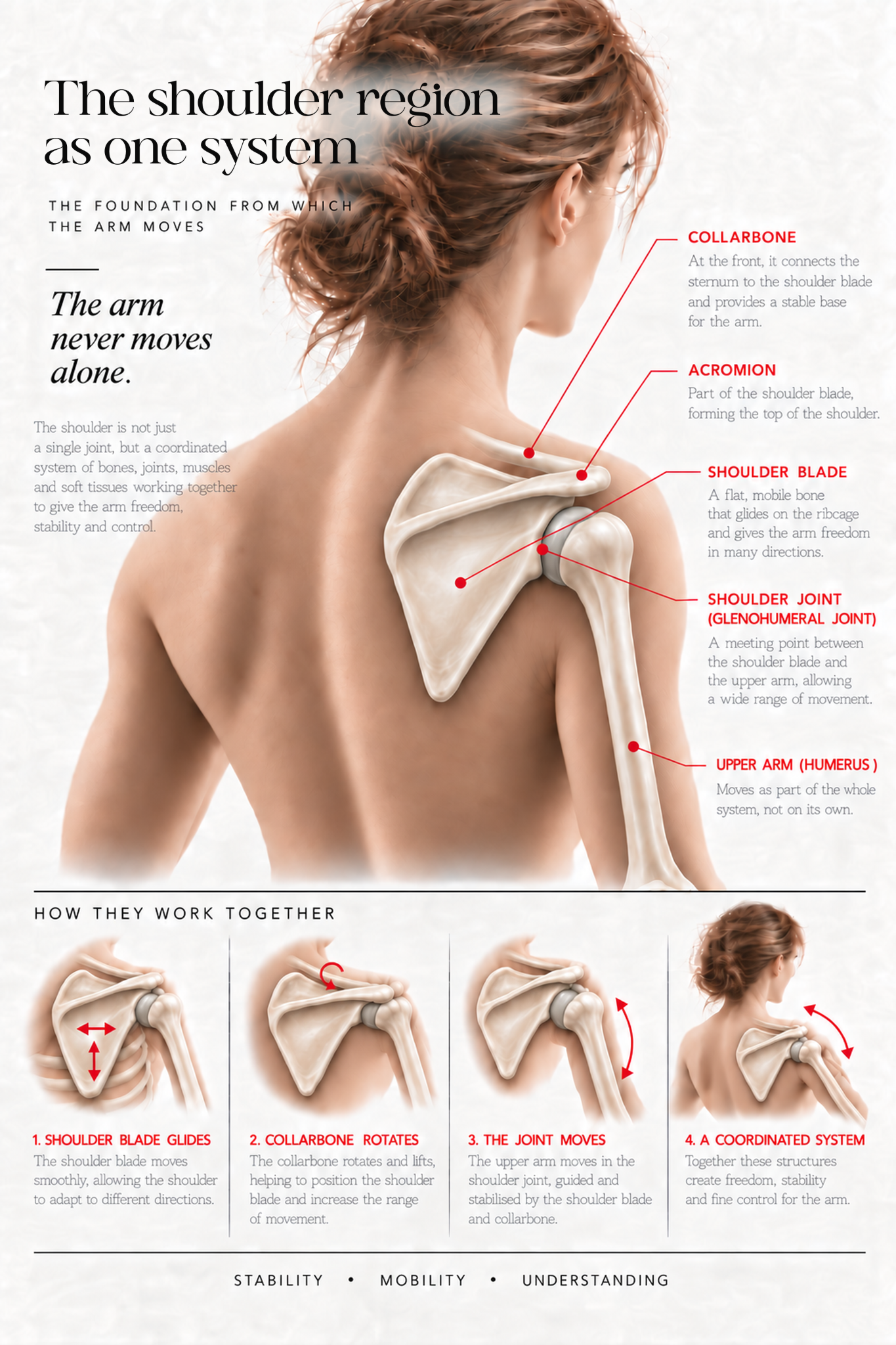
You don’t need to remember these names. Just remember one idea: The arm never moves alone.
Why does it matter.
There are four reasons - and they’re all connected.
Better movement requires less effort. When the shoulder region works as one system, no single joint has to do all the work. Playing immediately feels lighter.
Better movement creates better technique. Instead of fighting the instrument, your body starts working with it. Shifts, string crossings and bow changes become more reliable.
Better movement allows a freer, more resonant sound. A freer body allows the natural weight of the arm to travel into the string. Instead of forcing the sound, you begin allowing the instrument to resonate.
Better movement protects your body. Many playing-related injuries develop slowly through years of compensation. The better the movement, the less compensation your body needs.
What usually happens.
As I already mentioned, the body is incredibly good at adapting. If one part stops doing its job, another part quietly takes over and the movement becomes restricted. Over time, that extra work often appears as fatigue, stiffness or pain. Usually somewhere else. Not where the problem actually began.
One example.
Many violinists think the bow arm begins at the shoulder joint. In reality, every bow stroke also depends on the shoulder blade and collarbone moving together with the arm. When their movement becomes restricted, the elbow, wrist and fingers suddenly have much more work to do. What could feel like an elbow problem often begins elsewhere in the movement system. The elbow could be simply doing someone else’s job. This is why treating only the elbow often doesn’t solve the problem. The elbow may simply be compensating for movement that should have happened higher up.
Supporting the violin.
The violin doesn’t need to be held through unnecessary muscular effort. It rests on the collarbone and is supported by the natural weight of a balanced head. For this to happen, the head needs to balance freely on top of the spine. When that balance is lost, the neck, shoulders and arms begin working much harder than they need to.
Can this be learned online.
Absolutely. This isn’t about forcing your body into a position. It’s about understanding movement. Once the movement makes sense, your body often finds a better solution on its own.
Where to start.
The next time something feels difficult, don’t ask:
“How much time do I need to spend on this?”
Ask: “What makes this movement difficult? Where does this movement really begin?”
That single question often changes everything.
Questions I’m often asked.
Why isn’t relaxing my shoulder enough.
Because tension is usually a result, not the problem itself. Simply trying to relax a muscle rarely changes the movement that created the tension in the first place. When the whole shoulder region works more efficiently, unnecessary tension often disappears on its own.
Can this help even if I don’t have pain.
Absolutely. Most of my students simply want to play better. Pain is only one of many reasons people come to me.
Work on this together.
Whether you’re preparing for auditions, refining your sound or trying to solve a technical problem, understanding how your body works can make learning easier.
My goal is simple: to help you play with greater freedom, better sound, fantastic musicality and less unnecessary effort.
Work on this together. I’m Agata Kawa-Cajler, a Polish-born violinist based in Sweden. I teach online violin lessons rooted in body awareness - so that shifts, string crossings and bow changes stop fighting you and start working with your body. If tension or effort keep getting in your way, book a free introductory call. No commitment - just a conversation.