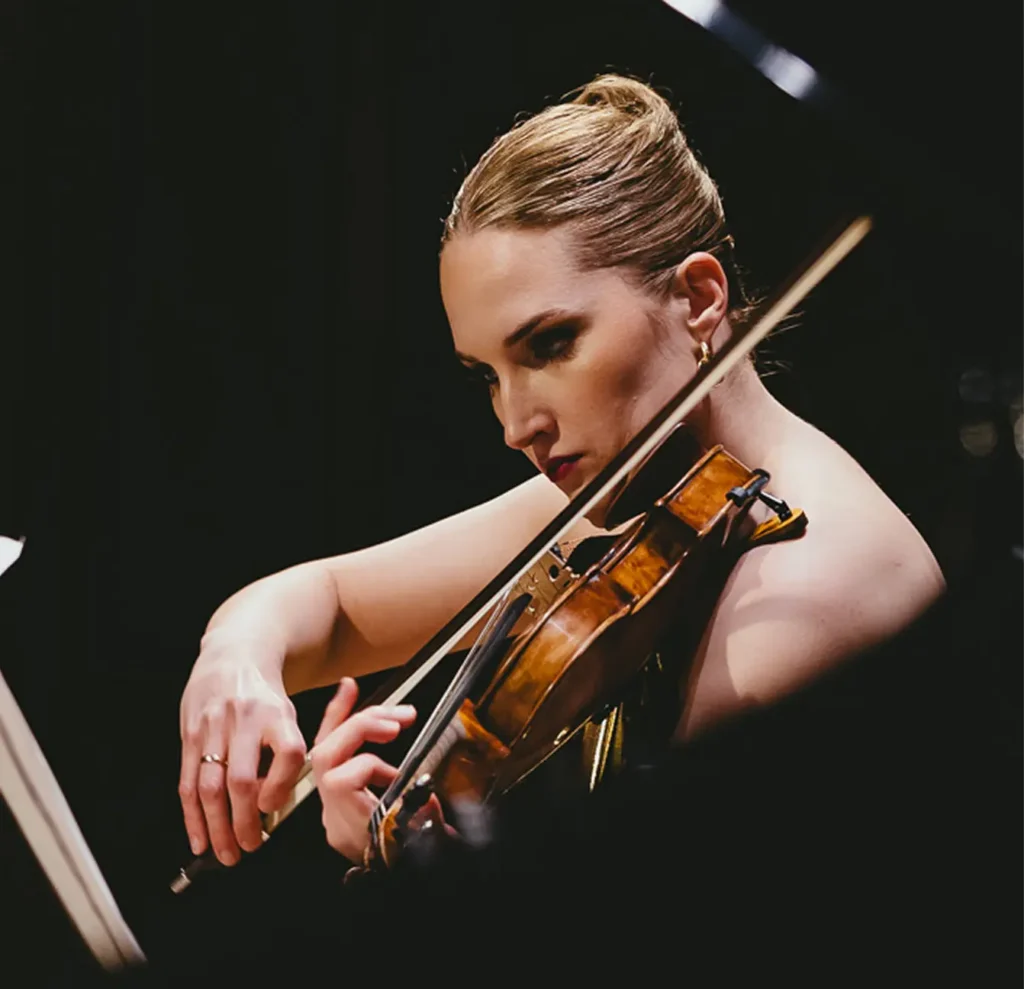
Most of us learned violin playing through instructions.
Hold the bow like this. Lift your arm. Relax your shoulders. Stand up straight.
Good violin technique isn’t a collection of rules or instructions to memorise. It grows out of something far more fundamental: the way the human body is designed to move. Once you understand that, technique stops feeling like a list of commands and starts becoming logical. Every movement has a purpose, and every purpose can be understood.
As children, we followed these directions without questioning them. Our teacher told us to do something, so we did it. What very few of us were ever taught was the part that matters most: why.
Why should this movement be done this way? Which muscles are actually responsible for it? Why does one movement create freedom while another creates tension?
That is where my teaching begins - I teach movement as part of violin playing.
I’d much rather you understand why something works than simply trust me because I told you so.
Technique that follows the body.
Every movement in violin playing works best when it follows the way the human body is designed to move. This applies to everything: the way you stand, the way you support the instrument, how you change positions, and how you move the bow across the string.
The violin has fixed dimensions. The human body does not.
We differ in neck length, arm length, hand size, finger proportions, shoulder width, muscle mass and joint mobility. Some of these differences are unique to each individual, while others are often seen between women and men. A technique that works beautifully for one player may be inefficient - or even harmful - for another.
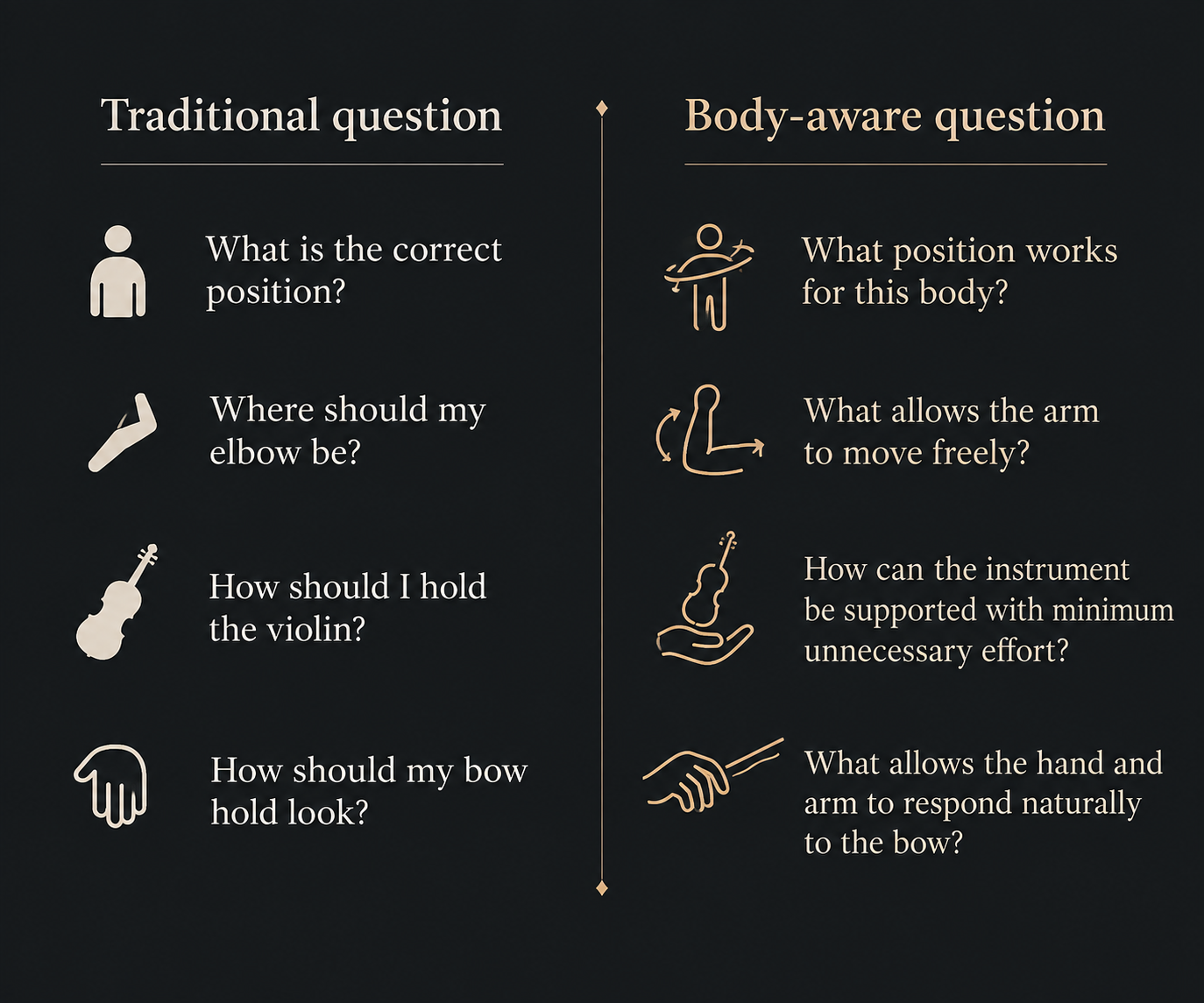
That is why the real question is never “What is the correct position?” Instead, it should be:
“How can this particular body perform this movement in the most natural and efficient way?”
Professional musicians are among the most physically demanding performers, yet our education rarely includes the same understanding of movement that athletes receive from an early age. We spend thousands of hours training our bodies, but surprisingly little time learning how those bodies actually work. In elite sport, understanding movement, biomechanics and efficient use of the body is a fundamental part of training because it improves performance and helps prevent injuries. I believe musicians deserve the same understanding.
That is the foundation of my teaching.
If you build your technique around your own anatomy, your body becomes your greatest ally. It will support you throughout your musical life. But if you repeatedly force it into positions that work against the way it is built to move, sooner or later it will begin to resist. The body is remarkably adaptable - but it also has its limits.
Why does it matter so much.
There are four reasons - and they’re all connected.
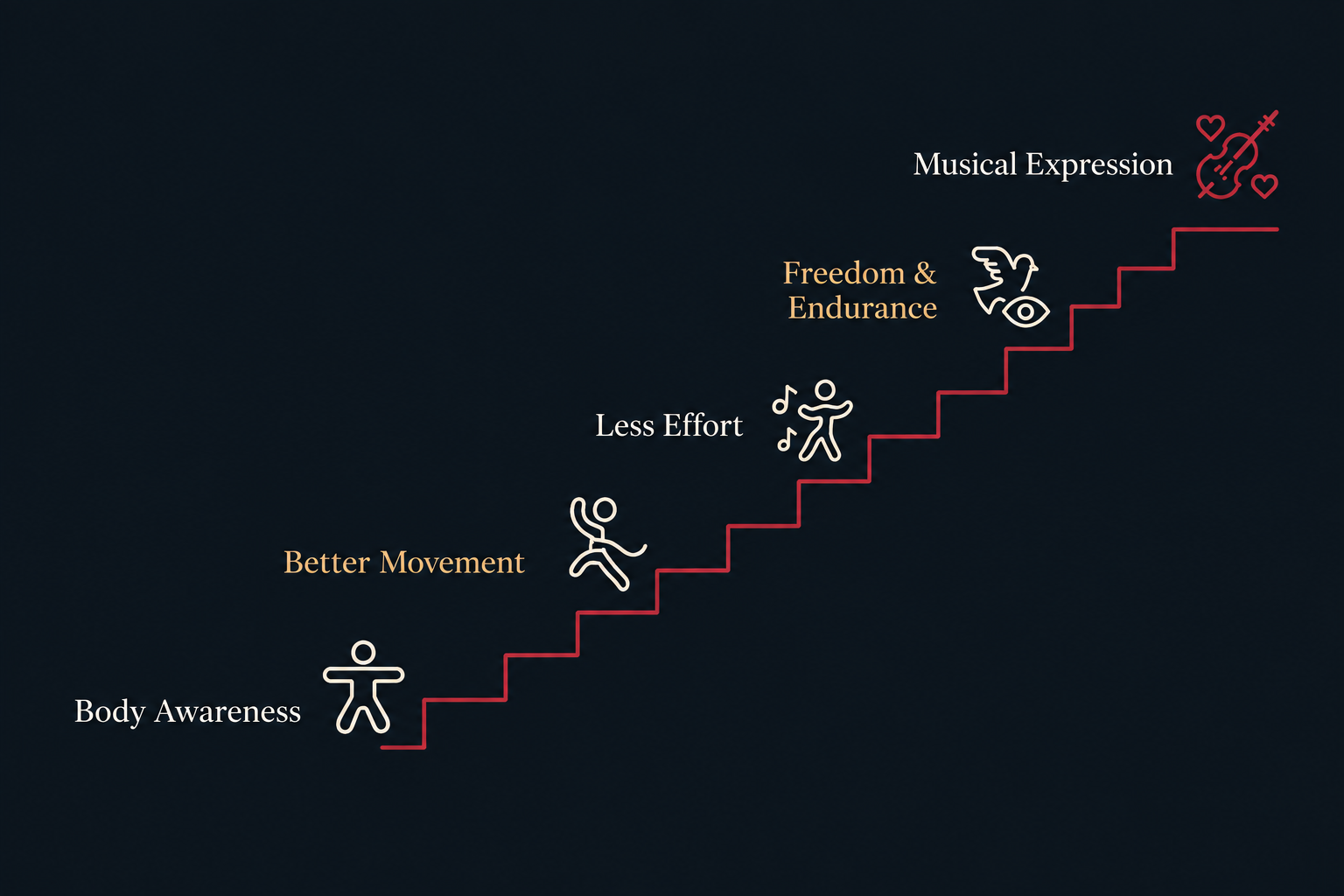
1. Better body awareness leads to better movement.
Before we can move efficiently, the brain needs an accurate understanding of how the body is designed to work. This internal “body map” in your brain influences every movement we make. When that map becomes clearer, movement becomes more natural, coordinated, and efficient - often without trying harder.
2. Better movement reduces unnecessary effort.
Many musicians work incredibly hard simply because their bodies are compensating for inefficient movement patterns. When the whole body works as an integrated system, unnecessary tension begins to disappear. Playing feels lighter, more balanced, and requires less physical effort.
3. Less effort means greater freedom and endurance.
Efficient movement allows you to play for longer with less fatigue and lowers the risk of playing-related pain and injuries. Instead of constantly managing discomfort, you can focus your energy on making music.
4. Greater freedom leads to greater musical expression.
When your body no longer limits your technique, your attention naturally shifts to sound, phrasing, and communication. A freer body allows the instrument to resonate more naturally, helping you create a richer tone, greater flexibility, and more expressive performances.
What happens when technique fights the body.
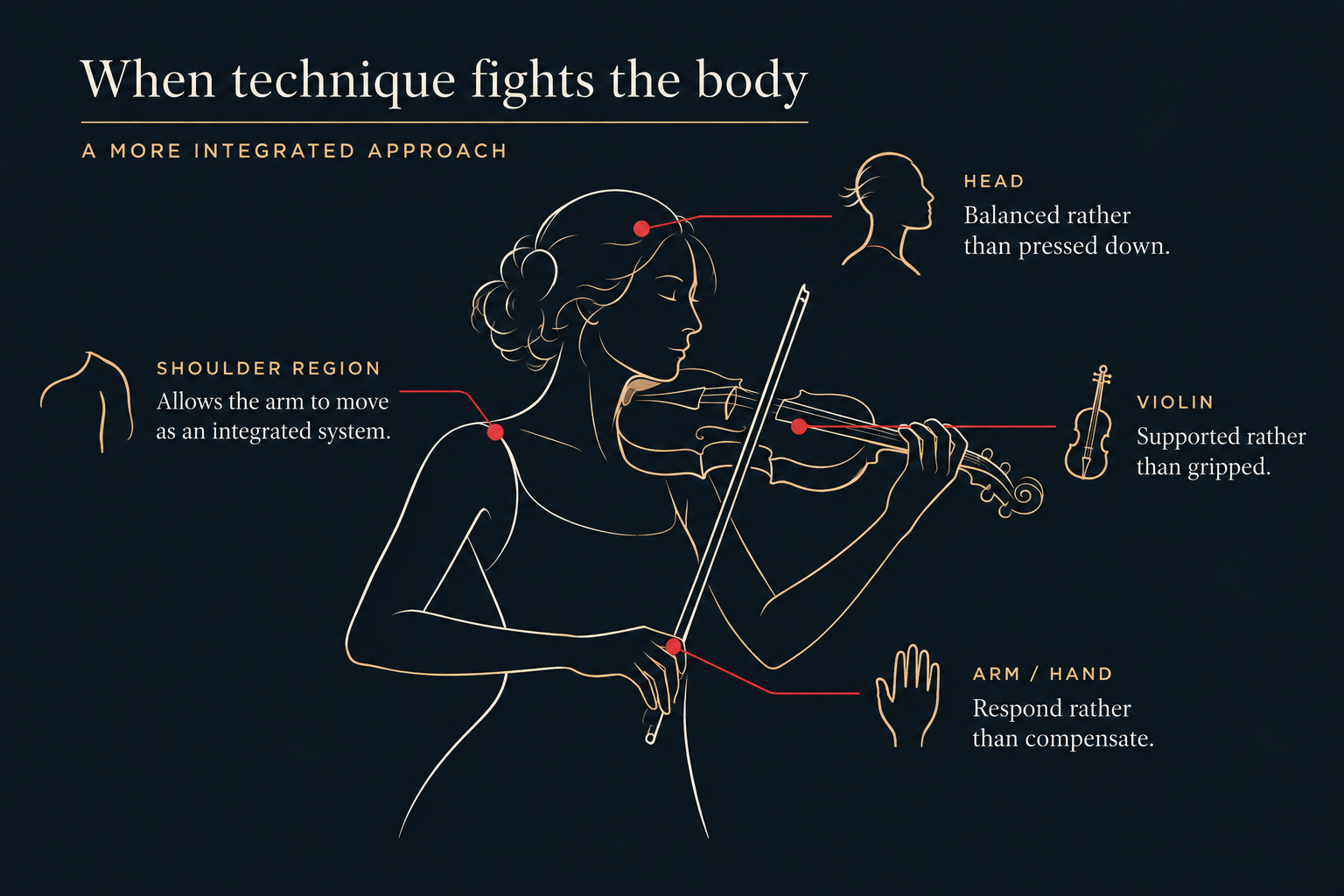
The body is designed to move as one connected system. Bones, joints and muscles don’t work in isolation - they constantly work together.
When one part of this system stops moving as it was designed to, the brain doesn’t simply stop the movement. Instead, it finds another way to achieve the same result. This is called compensation.
At first, compensation is almost invisible. You can still play, but the movement requires more effort than it should. Over time, these compensations become habits. The body works harder, movements become less efficient, and fatigue appears sooner. Eventually, the body starts sending signals that something isn’t working: stiffness, reduced freedom of movement, loss of control, and sometimes pain.
The important thing to remember is this:
Pain is rarely where the problem begins. More often, it is the final result of a movement pattern that has been compensating for months - or even years.
Here are a few common examples.
When the shoulder stops supporting the arm.
The arm never moves on its own. Every bow stroke depends on the coordinated movement of the shoulder blade, collarbone and upper arm. These structures are designed to work together as one system.
When this natural coordination is disturbed, the joints further down the chain begin to compensate. What feels like a problem in the elbow, wrist or hand often has its source elsewhere in the movement system.
When the head is no longer balanced.
Supporting the violin begins long before the left hand touches the instrument. It starts with the way the head balances on top of the spine.
When this balance is lost, the neck, shoulder girdle and arms begin working harder than they need to. Instead of allowing the skeleton to provide support, the muscles take over, making movement less efficient and much more tiring.
When the brain has the wrong map.
Your body can only move according to the map your brain has.
If that map is inaccurate, the brain gives the wrong instructions. It may ask a joint to move in a way it simply wasn’t designed to. The body finds a way to compensate, but the movement becomes harder, less efficient, and more tiring. The result is unnecessary muscular effort, reduced coordination, and compensations in other parts of the body.
When the violin is held instead of being supported.
The violin is not meant to be held by muscular effort. It rests on the collarbone and is supported by the body’s natural alignment and the weight of the head.
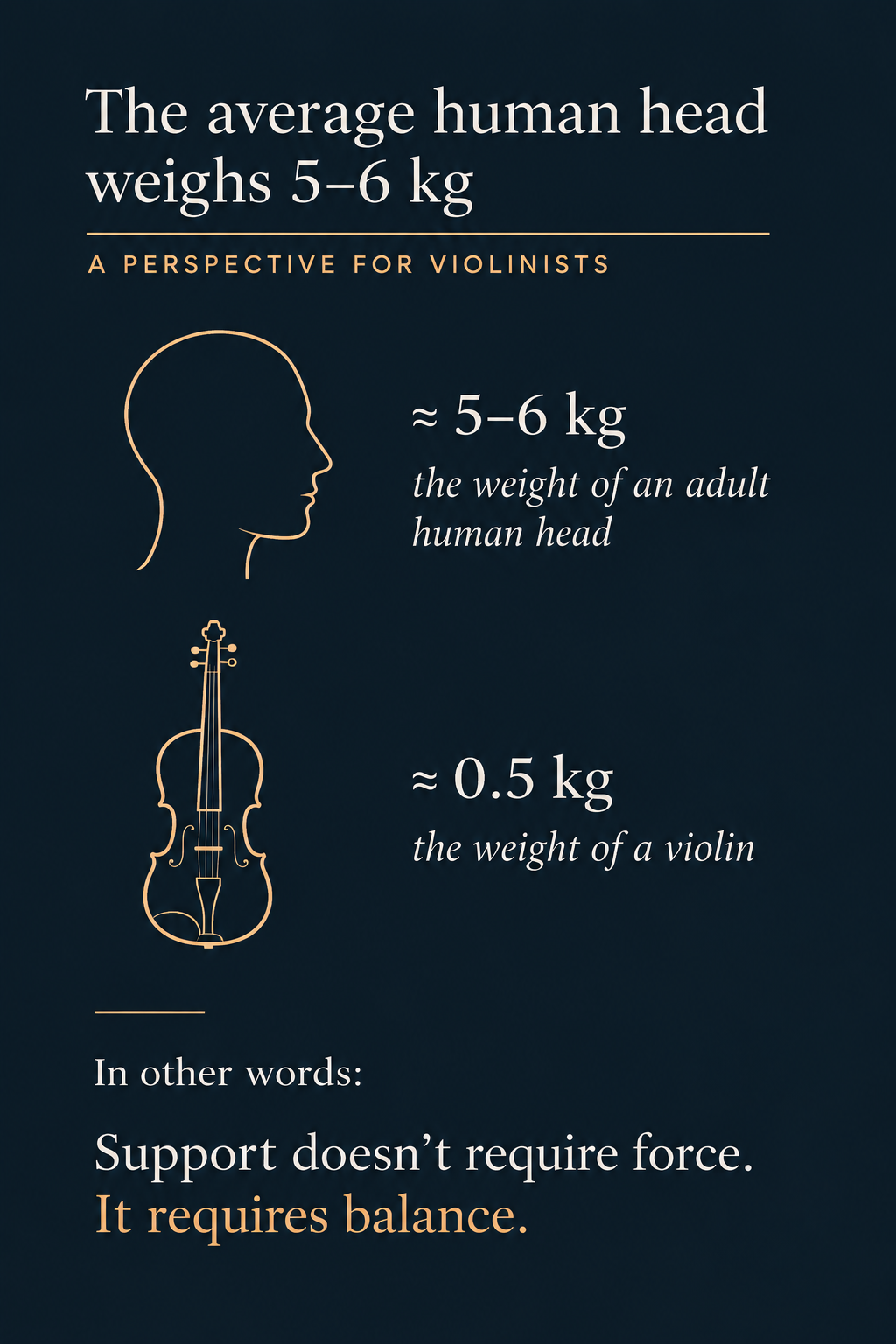
The average human head weighs around 5-6 kilograms - far more than a violin. When the head is balanced rather than pressed down, its natural weight can provide the support the instrument needs. This allows the left arm to remain free to move, shift and vibrate instead of trying to hold the instrument in place.
When the body starts supporting the violin with muscles instead of the body’s natural balance, unnecessary tension appears. The result is less freedom, less efficiency, and more effort.
Can this be taught online.
Absolutely.
Most of this work isn’t about physically moving your body - it’s about changing the way you understand it.
During an online lesson we analyse your posture, movement, setup and playing habits. Once you understand why your body moves the way it does, change becomes much easier - and that doesn’t require us to be in the same room.
Where to start.
You don’t need to learn a new technique.
You need to understand why your current one feels easy or difficult.
The goal isn’t to collect more instructions. It’s to recognise how your own body is organised, how it supports the instrument, and how each movement is connected to the next.
When you understand that, technique becomes clearer, movement becomes easier, and music has more space to come through.
Questions I’m often asked.
Do I need to be in pain to benefit from this.
Not at all. Most people come because they want to play more freely, improve their technique or develop their sound. Understanding how your body works simply makes learning easier - and often prevents problems before they start.
Is this just about ergonomics.
No. My goal isn’t to teach ergonomics - it’s to teach violin. Understanding the body is one of the tools I use to help students play more freely, solve technical problems and make music with greater confidence.
Can good technique really improve my sound.
Absolutely. When unnecessary tension disappears, movement becomes more efficient and the natural weight of the arm can travel into the string more easily. The result is a richer, freer and more flexible sound.
Work on this together.
I’m Agata Kawa-Cajler, a Polish-born violinist based in Sweden.
I teach online violin lessons for students who want to play with greater freedom, confidence and ease. Whether you’re preparing for auditions, refining your interpretation, improving your technique or trying to solve pain while playing, we start by understanding why something happens - not by memorising more instructions.
If tension, effort or pain keep getting in your way, book a free introductory call. No commitment - just a conversation.